
Steuben County's Multi-Day Arrest Blotter
The sheriff runs no web arrest log, no fixed seven-day feed, no searchable booking archive. So the multi-day trail runs through local news instead. WLKI's archive holds sheriff arrest reports, jail reports, weekend roundups, and single booking stories. WBET runs overlapping headlines. The Herald Republican prints formal blotter items, though a subscription or spotty indexing can block access.
Scope varies by story. One jail report covers one date. A weekend roundup spans several. WLZZ mixes northeast Indiana with southern Michigan. None of these is a county-only ledger, and none replaces the official booking record.
Reading Steuben County Arrest Reports
Start with the archives, then confirm each arrest record with the government custodian who keeps it. That habit keeps a dated news report separate from current custody.
- Open the WLKI archive and find a Steuben sheriff, jail, or arrest headline.
- Note the publication date, the event day stated in the article, and whether the report covers a weekend.
- Identify the arresting agency; jail placement does not prove the sheriff made the arrest.
- Compare the WBET archive, while avoiding duplicate syndicated events.
- Use MyCase or a written agency request for the cause number, release entry, and disposition.
For same-day needs, the Daily Arrest Report begins with current custody channels.
Fields in Steuben County Arrest Entries
Local stories capture only slices of a booking record, and the fields shift from article to article. Never guess at missing data.
| Field | Reading rule |
|---|---|
| Name | Confirm spelling and identity against an official record. |
| Arrest or report date | It may differ from publication and booking dates. |
| Agency | May be sheriff, city police, Indiana State Police, or another department. |
| Alleged charge | Not the final court count or a conviction. |
| Bond or release | A point-in-time status that can change. |
| Jail location | Placement at Steuben County Jail is distinct from arresting agency. |
| Photo | Some incident stories carry a supplied image, but the archive is not a photo roster. |
The WLKI archive screen shows repeated report formats across dates.

The capture illustrates archive navigation without presenting a gallery of arrested people.
Steuben County Weekend Arrest Roundups
A weekend-arrest headline can bundle several event days and several agencies into one count. People named inside may have bonded out before the story posted. Read the full piece for its stated window. A Monday publication date does not mean a Monday arrest. Treating the headline number as a 24-hour statistic is a mistake.
WLKI offers the strongest local archive. WBET echoes the pattern. The Herald Republican adds formal blotter coverage. WLZZ and U-Rock suit individual or regional stories once you check their geography. The WBET archive gives a second view of local report headlines.

A second archive can confirm a Steuben County report circulated. It cannot confirm current custody.
Past the Published Arrest Window
A news archive follows no sheriff's retention schedule. Indiana's Public Safety Agencies schedule keeps each record series for its own period. PSA 17-2 makes Level 1 through 5 felony files permanent. PSA 17-6 gives Level 6 felony files seven years. Police reports and case files under PSA 17-7 have their own clock. They generally last three years past final disposition. PSA 17-8 gives misdemeanor records seven years past charge.
No single online lifespan exists for a booking photo or arrest entry. A report can vanish while the official file survives. An unofficial copy can linger after the official source changes. The IARA county and local schedules page shows how custodians pick the controlling series.
Note: online visibility and official retention are separate, and a missing web result does not establish destruction, dismissal, sealing, or expungement.
Steuben County Thirty-Day Arrest Pages
RecentlyBooked claims its Steuben page covers the last 30 days and refreshes several times daily. That is the publisher's window, not county policy. The site is unofficial and can lag. Busted Newspaper also runs a Steuben category with booking-style records and photos. Government records and courts should anchor any verification. The RecentlyBooked Steuben section shows how a commercial rolling window differs from a dated archive.
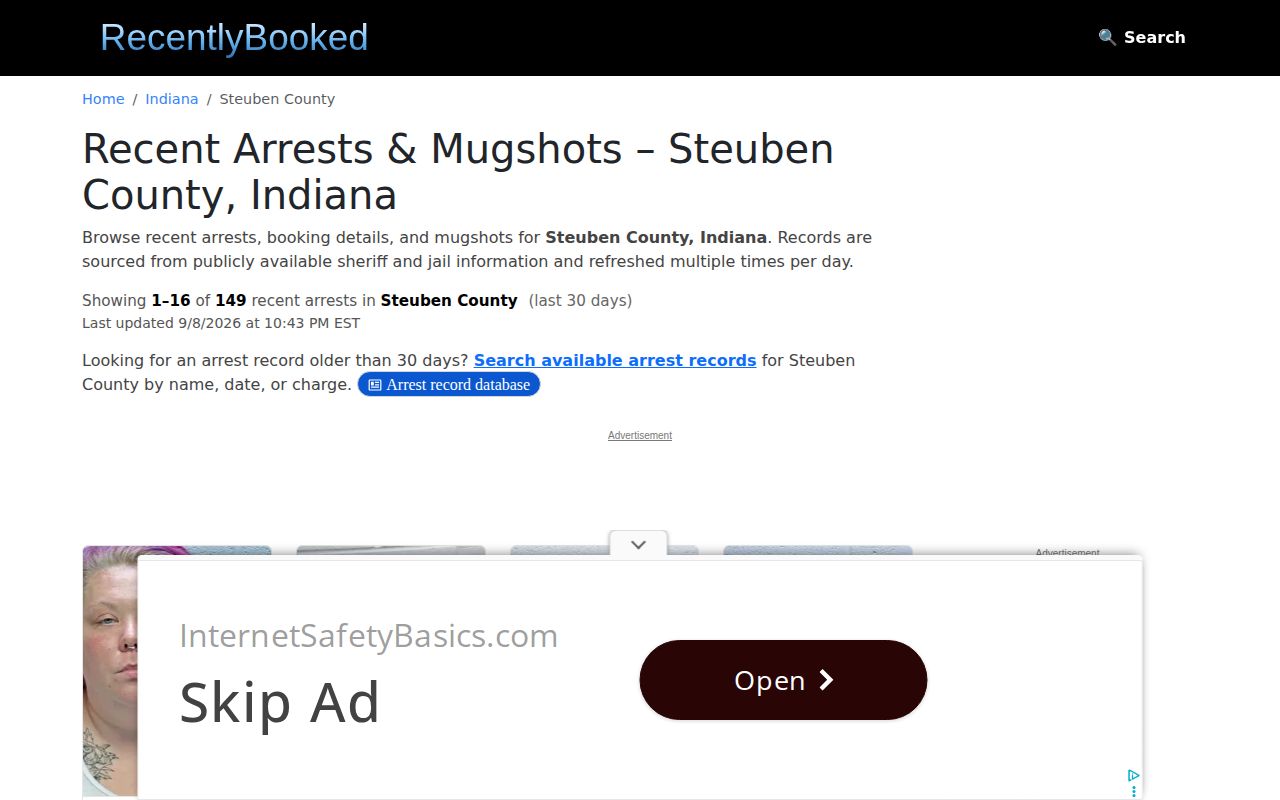
This secondary page displays no official roster and no reliable statement of current custody.
Requesting Official Steuben County Arrest Records
For an older arrest, start with the Steuben County Sheriff's records process. The office sits at 206 E Gale St in Angola. It requires a written request on its form. Staff can help at (260) 668-1000 ext. 5005 during weekday hours. Name the person, the date range, the agency, and any cause or booking number. Request the non-exempt booking, release, and photo records separately.
Indiana MyCase carries the court trail forward after booking. Charges can be amended, dismissed, or replaced, and some filings never appear online. The Steuben County records overview lays out how jail and court sources differ.
Can Steuben Arrest Logs Show Trends?
A string of arrest headlines cannot answer one question. Is crime rising or falling in Steuben County? Editors pick which arrests to print. Weekends bundle together, syndicated stories get counted twice, and agencies post on their own schedules. For real numbers, look at the official record. The sheriff's 2022 annual report logged 1,547 jail bookings. Leading categories were 390 OWI bookings, 324 failures to appear, and 213 battery or domestic-battery bookings. Those figures describe bookings, nothing more.
Want enforcement statistics? Use an annual report instead. Or try an Indiana reporting program that names its period and the agencies involved. Chasing one person's Steuben County arrest is a different job. The booking record and the court cause number answer that question. A week of headlines never could.
Agency labels deserve attention too. Angola Police, Fremont Police, Hamilton Police, the sheriff, and state officers each keep their own incident records. The county jail, meanwhile, may hold people arrested by any of them. When you need both halves of the story, make two requests. Ask the arresting agency for the incident report. Ask the jail custodian for the booking record.
News archives still serve a purpose. They preserve how an arrest was reported at the time, which no docket can match. But corrections, dismissals, acquittals, and changed charges surface in court alone. Search by cause number when you can. Compare dates, and leave out sensitive details that do not help verify anything.
Which Agencies Feed Steuben Arrest Logs?
The phrase "Steuben County arrest log" quietly covers several record keepers. Angola Police writes its own incident reports. So do Fremont Police and Hamilton Police in their towns. The Steuben County Sheriff handles sheriff incidents. It also keeps all jail booking material. Indiana State Police can be the arresting agency in some matters. One short news roundup may mix all of these together without saying so.
No agency named in an arrest item? Ask the jail who delivered the person. Then pull the cause number and read the court docket. Never guess the department from the jail's street address. The county Communications/E911 operation dispatches most agencies around the clock. Its official page, though, excludes Angola City Police and Fire. Dispatching an arrest is not the same as publishing an arrest log. That gap explains a common dead end. County geography alone never points you to the right agency file.
A sharp archive search starts with the person's name. Add a rough date, the place, the agency, and the headline wording. A records request works best with those same facts plus a cause or booking number. If an agency redacts or denies material, ask for the statutory basis. Request the non-exempt portions as well. Indiana's deadlines govern acknowledgment, not instant production of a complex historical file.
Old newspapers are a historical trail, not the official booking archive. A dated article can preserve a public account after a page disappears from the web. It may skip a correction or later court action, though. Treat the article, the official file, and the court disposition as three distinct sources. Each has its own job.